Table of Contents
Recently, major companies have faced criticism for driving coal expansion.
According to a Philippine Center for Investigative Journalism (PCIJ) article, conglomerates hold the key to the Philippines’ clean energy future: while funding renewables, they keep investing in fossil fuels, citing the need for a balanced energy mix. “But climate activists say they are slowing the rollout to maximize profits,” it stated.
However, Manila Times columnist Ben Kritz was quick to refute the claim, saying that precisely because of their scale, financial resources, and existing infrastructure, conglomerates were well-positioned to drive the country’s renewable energy (RE) transition. He suggested that these firms could take a leading role in adopting and expanding clean energy, effectively acting as champions in the shift toward sustainable power.
Conglomerates driving renewables
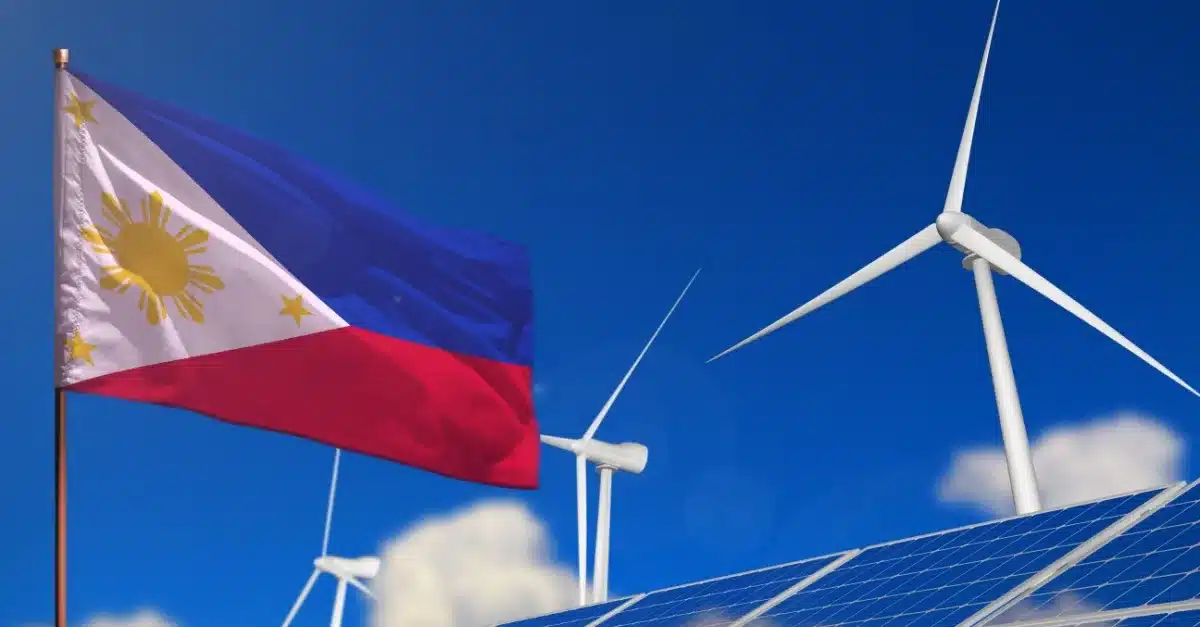
The Department of Energy (DOE) aims for 35% of the Philippines’ power mix to come from renewable sources by 2030 and 50% by 2040. Leading the way, major corporations are investing heavily in solar, wind, and geothermal projects, demonstrating a strong commitment to a cleaner, sustainable energy future.
- ACEN Corporation
Parent firm: Ayala Corporation
Current, under construction, and committed capacity: 6.8 gigawatts (GW) as of end-2024
Major RE projects: 90-GW Palauig and 450-GW Palauig 2 (Palauig, Zambales) Solar Farms; 81-megawatt (MW) North Luzon Renewables Wind Project (Pagudpud, Ilocos Norte); 500-MW wind energy project (Real, Quezon); 200-MW solar farm (San Marcelino, Zambales)
Key metrics: 20 GW of RE capacity by 2030
Recognition: ACEN’s Pagudpud wind project received the DOE’s 2024 Sustainable Energy Award for On-Grid RE Projects, having generated 205,000 MWh to power roughly 50,000 homes and cut carbon emissions by 144,000 tons annually.
- Energy Development Corporation (EDC)
Parent firm: Lopez Holdings Corporation
Installed capacity: 1,480 MW, roughly 20% of the Philippines’ total installed RE capacity
Major RE projects: 28.9-MW Palayan Binary Geothermal Power Plant (Manito, Albay), part of the 140-MW Bacon-Manito expansion; 5.6-MW geothermal plant (Bago City, Negros Occidental); 20-MW Tanawon Plant (BacMan Complex, Sorsogon City); 28-MW Mahanagdong plant (Ormoc, Leyte)
Key metrics: Contributes 1,185 MW or about 61% of the Philippines’ total geothermal capacity.
Recognition: Named Green Company of the Year at the 2024 ACES Awards in Bangkok, recognizing its leadership in Philippine RE and biodiversity efforts.
- Aboitiz Renewables, Inc.
Net attributable RE capacity: 1.4 GW as of end-2024
Major RE projects: 94-megawatt peak (MWp) Cayanga Solar (Bugallon, Pangasinan); 159-MWp Laoag Solar 1 & 2 (Laoag, Pangasinan); 17-MW Tiwi Binary Geothermal (Tiwi, Albay); 45-MWp Armenia Solar (Armenia, Tarlac); 173-MWp Calatrava Solar (Calatrava, Negros Occidental)
Key metrics: Aims to expand its RE portfolio to 4,600 MW by 2030.
Recognition: Won the 2025 CSR Guilds Award for Outstanding CSR Project for Arts and Culture for Project Tahi ‘Ta!, a program empowering Higaonon women in Bukidnon.
- MGen Renewable Energy, Inc.
Parent firm: Manila Electric Company (Meralco)
Net sellable capacity: almost 400 megawatts alternating current (MWac) across Bulacan, Isabela, Nueva Ecija, Rizal, Ilocos Norte, Tarlac, and Batangas
Major RE Projects: 52.8-MW solar plant (Cordon, Isabela); 3,500-MWp MTerra Solar (across Nueva Ecija & Bulacan); 4,500-MWh energy storage; 550-MW Bugallon Solar Power Project (Bugallon, Pangasinan); 81-MWac Baras Solar Project (Baras, Rizal)
Key metrics: Poised to surpass its 1,500 MW RE capacity target by 2027—three years ahead of schedule.
Recognition: CEO Emmanuel V. Rubio was named CEO of the Year at the 2025 Asian Power Awards, while its Baras Solar project won Power Plant Upgrade of the Year – Philippines.
Why a pragmatic approach is necessary
The PCIJ article highlighted the pragmatic approach in the Philippines’ RE transition, noting that conglomerates continue fossil fuel investments, “citing the supposed need for a ‘balanced energy mix’ to guarantee reliable and affordable power.”
However, real-world examples have shown the consequences of rushing the green shift.
The UK, for instance, once had some of Europe’s cheapest electricity in the early 2000s but now faces some of the highest prices in the developed world. Businesses pay at least 50% more than most European competitors and over three times the US rate. Rising gas prices from the Ukraine war worsened the situation, but an aging grid, limited renewable storage, and high policy costs keep bills high.
In fact, former UK Prime Minister Boris Johnson admitted he moved “far too fast” on net zero. He said he got “carried away” by the potential of RE to replace fossil fuels, leaving electricity “too expensive for ordinary people.”
Meanwhile, the Netherlands is facing growing pains from its RE boom. The electricity grid is struggling as demand and supply outpace infrastructure, creating “grid congestion” where excess solar and wind power overloads the system. Additionally, the NL Times reported that the Netherlands saw 27,341 power outages in 2024, a 17% increase over the five-year average.
At a recent forum hosted by the Economic Journalists Association of the Philippines, DOE Undersecretary Mylene Capongcol emphasized that the country’s long-term energy plan seeks to provide all Filipinos with reliable and affordable electricity.
“I think when we talk about transition, it’s not cheap,” she added. “It’s expensive because it involves new and innovative technologies like battery energy storage, but eventually, the cost is going down.”
Echoing this view, Energy Regulatory Commission (ERC) Chairman and CEO Francis Saturnino Juan noted, “Aggressively pursuing renewable energy supports sustainability but may increase costs if not carefully managed.”
(Also read: Gov’t Offices Required to Adopt Energy Efficiency)
Addressing climate change
The PCIJ article pointed out coal as “the single largest source of carbon dioxide emissions, which triggers global warming and extreme weather such as stronger typhoons, heavier floods, and prolonged droughts.”
Still, it also acknowledged the International Energy Agency’s (IEA) 2022 findings that the Philippines accounts for only 0.4% of global carbon dioxide emissions. This share is so small that even major local reductions would hardly make a dent in the world’s total output.
Because the Philippines is an emerging economy, with limited resources and pressing development needs, investing heavily in the green transition may not always be cost-effective.
Political scientist Bjorn Lomborg, in his paper entitled “Welfare in the 21st century: Increasing development, reducing inequality, the impact of climate change, and the cost of climate policies”, noted that climate policies can sometimes cost more than the environmental benefits they deliver.
He highlighted, “The Paris Agreement, if fully implemented, will cost $819–$1,890 billion per year in 2030, yet will reduce emissions by just 1% of what is needed to limit average global temperature rise to 1.5°C.”
Instead of a zero-carbon approach, Lomborg supports a fossil-fuel–driven strategy focused on rapid economic growth. He argues that this scenario could raise average annual incomes for today’s poor by $48,000 by 2050, cut poverty by 26 million people each year, reduce inequality, and prevent more than 80 million premature deaths, even after factoring in climate damages.
For Lomborg, climate change costs are often overstated because the benefits of adaptation are overlooked. Coastal flooding, for example, is frequently projected to cause tens of trillions in damages annually, yet realistic estimates accounting for adaptive measures show far smaller economic and social impacts.
He wrote, “… even an extremely stingy adaptation would reduce costs by 88%, and any realistic adaptation would reduce it much, much more,” he wrote.
Similarly, Microsoft co‑founder and philanthropist Bill Gates emphasized that human welfare should guide climate action. “Although climate change will have serious consequences – particularly for people in the poorest countries – it will not lead to humanity’s demise,” Gates wrote in his essay. “This is a chance to refocus on the metric that should count even more than emissions and temperature change: improving lives. Our chief goal should be to prevent suffering, particularly for those in the toughest conditions who live in the world’s poorest countries.”
(Also read: Accelerating Renewable Energy Goals: Who Truly Benefits?)
Ensuring a just energy transition for all
While conglomerates have drawn criticism for continuing fossil fuel investments, their capacity and operational reach allow them to lead the Philippines’ RE shift. These firms can accelerate the green transition while keeping electricity accessible and affordable for all.
A just energy transition means balancing sustainability with equity: communities must benefit from cleaner energy through locally owned and resilient projects, while careful planning helps avoid steep cost burdens.
While ambitious climate targets are vital, measures must consider development priorities, adaptation, and long-term economic welfare. Conglomerates, with their capacity and leadership, can champion a transition that is both sustainable and inclusive, ensuring that the green shift strengthens the nation rather than leaving ordinary citizens behind.
Sources:
https://legacy.doe.gov.ph/energy-information-resources?q=power-development-plan
https://mb.com.ph/2024/12/16/acen-eyes-1-2-gw-of-additional-capacity-in-2025
https://www.philstar.com/business/2025/08/30/2469016/acen-infusing-p46-billion-clean-energy-projects
https://www.philstar.com/business/2024/08/02/2374710/acen-takes-over-quezon-wind-project
https://qa.philstar.com/business/2024/07/07/2368250/edc-switches-p7-billion-geothermal-plant-albay
https://www.energy.com.ph/who-we-are
https://www.energy.com.ph/edc-hailed-green-company-of-the-year-at-aces-awards-2024
https://tribune.net.ph/2025/01/15/mgen-vena-energy-to-generate-7000-jobs-in-pangasinan-re-project
https://aboitizpower.com/about-us/our-businesses/power-generation/cleanergy/aboitiz-renewables-inc
https://aboitizpower.com/news/solar/aboitizpower-s-solar-milestones-lead-its-renewable-energy-drive
https://theweek.com/tech/why-britains-electricity-bills-are-some-of-the-highest-in-the-world
https://www.telegraph.co.uk/politics/2025/10/05/boris-johnson-too-far-too-fast-net-zero
https://www.bbc.com/news/articles/cn40y9yxkgvo
https://www.sciencedirect.com/science/article/pii/S0040162520304157
https://edition.cnn.com/2025/10/28/business/bill-gates-climate-change