Table of Contents
Global solar expansion continued at a breakneck pace in 2024, with the International Energy Agency (IEA) reporting 553 to 601 gigawatts (GW) of new PV capacity added worldwide, which is a 29% jump from the previous year. This surge reflects falling module prices, stronger climate commitments, and China’s push to absorb its massive manufacturing output.
China continued to dominate global solar growth, adding an estimated 309 to 357 GW and accounting fornearly 60% of all new PV installations. The EU remained the next major hub, contributing about 66 GW, with Germany, Spain, Italy, France, and Poland driving most of the expansion. Worldwide, the technology’s rapid scale-up is evident in the rising number of countries reaching GW-level annual markets.
That surge is seen locally as well. According to the Department of Energy (DOE), the total national installed solar PV capacity stood at 2,710 megawatts (MW) as of year-end 2024.
However, with solar now established as one of the world’s leading new power sources, its rapid build-out also sets the stage for an equally rapid rise in end-of-life panels in the decades ahead. This is a challenge that policymakers have yet to fully confront.
(Also read: Consumers hail ERC Hearing as Turning Point for Davao’s Power Future)
A global waste problem
In 2016, it was estimated that between 43,500 and 250,000 metric tons of solar panels had already been discarded, and this volume is projected to grow dramatically. By 2040, global PV waste could contain roughly 2.7 million tons of aluminum, 8,250 tons of silver, and 166,500 tons of copper- and polymer-based cabling.
Meanwhile, the IEA warns that solar panel waste will escalate sharply in the coming decades, potentially reaching 78 million metric tons globally by 2050.
Ben Kritz of the Manila Times wrote that the US Solar Energy Industry Association recently held its first sustainability conference, where a pressing question dominated: what happens to solar panels once they reach the end of their 20 to 25-year lifespan? With large-scale solar projects in the US now about 15 years old, experts warn that by 2030, huge volumes of panels will need proper disposal.
“What seems to have disturbed the industry participants at the SEIA conference is that the US Environmental Protection Agency (EPA) has dropped the ball on providing guidance for handling discarded solar panels,” stated Kritz. “In 2023, it had promised to create a draft rule reclassifying dead solar panels as ‘universal waste,’ a category for materials that need specialized handling, such as batteries, pesticides, and mercury-containing devices, by the end of this year.”
As the year closes, no formal proposal has been released. The EPA now plans to unveil one by February 2026, aiming for implementation in August 2027.
With no set regulations, US solar developers face a patchwork of state and local rules on panel decommissioning,creating uncertainty for both existing and new projects. A federal framework would not replace local policies but could provide more consistent and predictable guidelines for managing solar waste.
“A similar situation exists here in the Philippines, where there is no specific policy governing the disposal of solar panels, so that is subject to general solid waste management laws, local government rules, specific stipulations, if any, in environmental compliance certifications, and the goodwill of solar developers to follow industry best practices,” observed Kritz.
The government’s failure to address solar panel disposal is a significant oversight, especially amid the push to expand renewable energy. While manageable so far, the rapid growth of large-scale solar projects means that by 2035 or 2040, the issue could become a major challenge.
Repowering solar farms
Repowering is the practice of modernizing an existing solar PV plant by replacing dated panels, inverters or other components with newer, higher-performing technology. Instead of building on new land, operators upgrade what they already have, boosting output while extending the life of the site.
Repowering delivers practical financial and regulatory advantages. Higher efficiency accelerates cost recovery, with many projects recouping the investment within a few years through increased production and lower maintenance needs. New components also come with longer warranties and greater reliability, reducing unplanned downtime.
However, research shows that technological advances and repowering lead to premature replacement of older PV modules, meaning panels are discarded before their natural 20 to 30-year lifespan and increasing the volume of decommissioned modules that must be dealt with.
Without strong recycling systems, the rise in discarded panels presents challenges, since valuable materials like silicon, glass, and metals must be recovered rather than landfilled to avoid environmental harm; research stresses the need for circular economy strategies and improved end-of-life management to capture these resources.
Solar energy’s dark side
The EPA notes that solar panel testing has revealed variations in the metals used in semiconductors and solder. Some panels contain hazardous substances such as lead and cadmium, which can pose serious risks to human health and the environment if exposure levels are high. Without proper disposal, however, panel scan leach toxins into soil and groundwater,threatening both ecosystems and human health.
Aside from mitigating health risks, recycling efforts can reclaim valuable metals and materials, reducing the need for new raw resources.
According to Joshua Antonini of the Mackinac Center for Public Policy, most solar cells rely on polysilicon, a material derived from mined quartz. While safeguards exist to protect miners from illnesses like silicosis, much of global photovoltaic production since 2008 has shifted to countries with weaker environmental and labor regulations than those in the US.
The scale of solar panels’ environmental impact is further highlighted by rising emissions from their manufacturing, which have quadrupled over the past decade to exceed 51,900 kilotons of carbon dioxide.
“In fact, solar produces 300 times more toxic waste per unit of energy than does nuclear energy, according to Environmental Progress, a Berkeley, California, nonprofit that supports the expanded use of nuclear energy, ”wrote Antonini.
In the Philippines, laws governing waste management exist, such as the Ecological Solid Waste Management Act (RA 9003) and the Toxic Substances and Hazardous and Nuclear Wastes Control Act (RA 6969), but no regulation yet specifically addresses solar panel recycling.
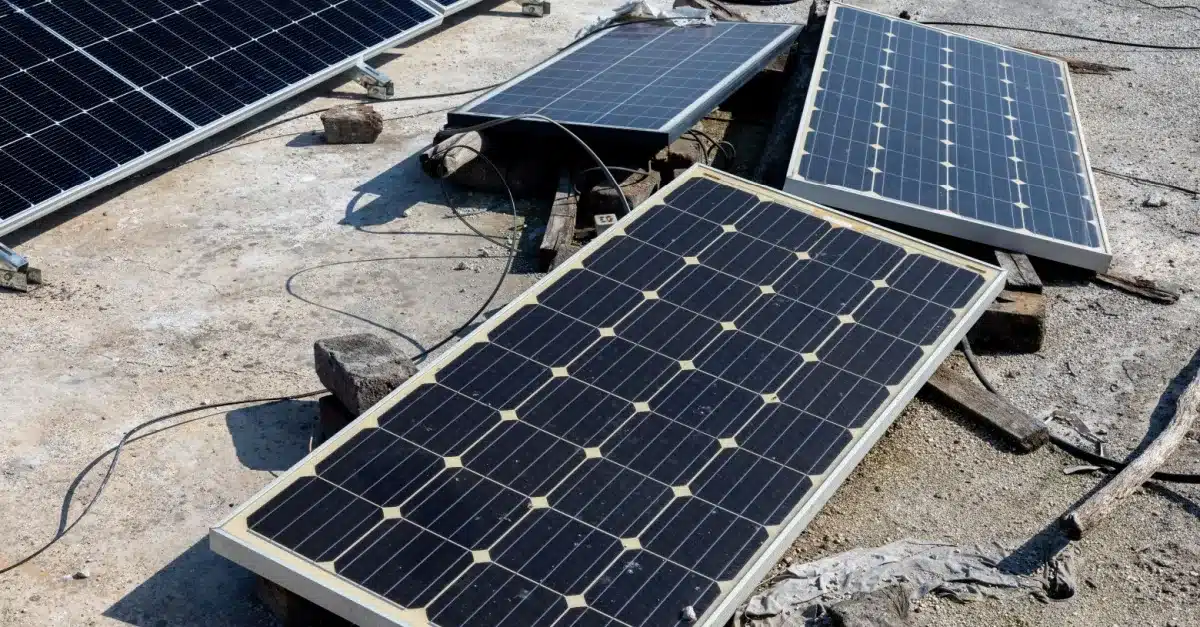
Without a nationwide recycling system, end-of-life solar panels face multiple risks. Landfilling, while simple , wastes valuable materials like glass, aluminum, and precious metals. Panels may also enter the informal e-waste sector, where crude extraction methods can release toxic chemicals andpose serious hazards to workers and nearby communities. Others may remain in long-term storage at solar farms or warehouses, creating logistical and safety challenges.
“A typical solar voltaic panel contains mostly glass, about 70 to 80 percent, with 10 percent aluminum, 10 percent mostly unrecyclable polymers, and small but still valuable amounts of silver, copper, tin, and lead,” pointed out Kritz. “To recover all these materials, the sandwiched layers of the panels have to be pulled apart, something for which processes to do that at scale have not yet been invented.”
(Also read: Southeast Asia Races Toward Solar-Wind Integration, Yet Hard Realities Remain)
Illuminating the next steps
The promise of solar energy is clear: to reduce carbon emissions and protect the planet. Yet the aggressive push to adopt solar power globally may carry unintended consequences, potentially harming both the environment and public health. Rapid deployment without careful planning and assessment risks creating new hazards that undercut the very goals renewable energy is meant to achieve. For environmental advocates, this paradox is particularly jarring: the solution they champion could inadvertently worsen the problems they are trying to solve.
In the Philippines, the stakes are even higher. Solid waste management remains unevenly enforced across the country, and compliance is often inconsistent. Introducing large volumes of solar panels into this fragmented system only compounds the challenge. Without a clear, nationwide framework for recycling and safe disposal, the growth of solar energy could generate hazardous waste, contaminating soil and water and posing risks to communities. The urgent need is for policies and infrastructure that ensure solar power truly remains a sustainable and safe alternative.
For Kritz, the solution lies in establishing clear policies that support solar panel recycling. Addressing it requires a regulatory framework that encourages investment in an effective waste-management infrastructure.
“… it should be emphasized that the typical way problems like this are addressed by the Philippine bureaucracy — in this case, it would be a stipulation that prospective solar developers include a waste management plan in their applications — will in no way be a clear, effective, and capital-attractive solution,” he wrote. “They have a few years to work on the problem, so it is not an immediate crisis. But it might be, if that work is not undertaken.”
Beyond setting clear rules for handling end-of-life solar panels, a more responsible approach is to require developers to practice true cradle-to-grave planning, which is also known as product stewardship. This approach covers the entire lifecycle of a project, from manufacturing and installation to operation, decommissioning and material recovery. By embedding stewardship into the development process, solar projects are treated as long-term environmental commitments with defined responsibilities at every stage.
A key part of this approach is ensuring that developers properly cost in the disposal and recovery of panels before construction begins. Including these expenses in project planning encourages better design decisions, promotes the use of more recyclable components and prevents future cleanup burdens from being passed on to communities or governments. When combined with strong end-of-life policies, cradle-to-grave planning helps ensure that the growth of the solar industry remains sustainable while limiting the long-term environmental impacts of discarded PV equipment.
Sources:
https://iea-pvps.org/trends_reports/trends-2025
https://legacy.doe.gov.ph/sites/default/files/pdf/energy_statistics/02_Summary.pdf
https://www.mdpi.com/1996-1073/18/7/1844
https://www.manilatimes.net/2025/12/04/opinion/columns/the-coming-solar-panel-tsunami/2236300
https://www.epa.gov/hw/end-life-solar-panels-regulations-and-management
https://www.anernstore.com/blogs/diy-solar-guides/end-of-life-solar-panel-mistakes
https://www.mackinac.org/blog/2022/bright-panels-dark-secrets-the-problem-of-solar-waste
https://solarinstallph.com/blog/solar-recycling-sustainability
https://www.sciencedirect.com/science/article/abs/pii/S0959652625002914